Here is a translation of Cyrus Shepherd's article "21 Smart Tips for SEO in Google for 2021"
Greetings MOZ fans! I present to you a new installment of Whiteboard Friday. I'm Cyrus Shepherd, glad to have you with us today. I want to share 21 savvy Google SEO tips for 2021. The new year brings with it new strategies for getting ahead in SEO. Hopefully these tips will help some of you adjust to the conditions and grow organic traffic.
.gutentoc-toc-wrap ul li a, .gutentoc-toc-title-wrap .text_open{ color: #2b6dad}}
These are some of the best tips I've collected over the past year. Many of them I am going to put into practice myself.
21 tips from Cyrus Shepherd
So, for convenience, I've divided the tips into 4 groups: increasing clickability (CTR), improving content, technical optimization of the site and link promotion.
Improved CTR
Let's start with clicks. Specifically, with getting more clicks without improving rankings. Because that's one of the cool things about SEO. You don't actually have to rank higher to get more traffic if you can get more clicks from the positions you already have. So let's talk about a few specific strategies for getting clicks without improving rankings.
Optimizing the favicon
First, optimizing the favicon.
I'm surprised this technique hasn't been discussed by more people in 2020 than before. Google displays favicons in mobile search results and they can affect your click ranking if they have high contrast, if they are visible or not. The right favicon only tips a couple percent towards clickability. Not much, but it makes a difference if done well. Aaron Wall of SEO Book wrote one of the posts on this topic.
Optimization of breadcrumbs
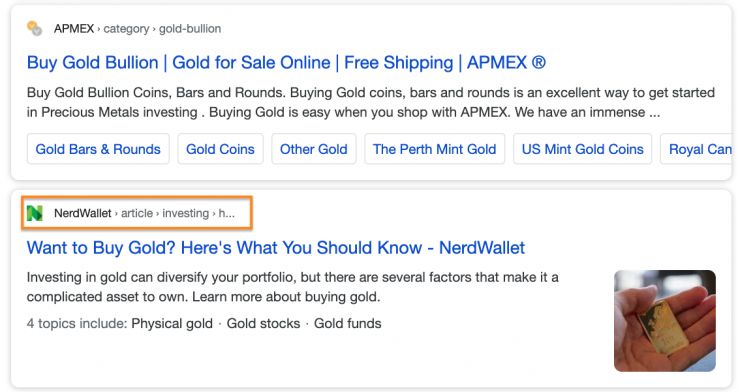
While you're improving your favicons, let's turn our attention to optimizing breadcrumbs. Google shows them in both desktop and mobile search results. These can be breadcrumbs with keywords that directly affect CTR. Google now sees breadcrumbs in many places: both in URLs, schema markup, and on the page itself.
Make sure Google displays the breadcrumbs you want to see and uses the keywords you set. The best way to double-check breadcrumbs with links on your page is to use schema markup. Ideally it will match the structure of your URL, but that doesn't always have to be the case. So yes, you should do a breadcrumb audit.
Meta-description
Let's optimize the meta-description. It belongs to the old school of SEO. But a recent study showed:30% of websites simply don't do a description. Now the results of another study become clear. According to it, in 70% of cases Google rewrites descriptions because they are missing keywords that users use in their searches. But if we write a quality meta description, it can encourage users to click on the snippet.
And that means using a description with lots of keywords that people are actually searching for. So when Google does use your description, it encourages those clicks and acts as marketing copy for your site.
Numbers in headlines
Along with description, titles are also important. Just to share a recent study that numbers added to a title increase brand rankings. Generally, numbers are what I always test in titles and they always produce consistent results. In particular, dates in title tags have become my favorites for January 2021.
But don't spam them. Don't include numbers in titles if it doesn't make sense and don't fake the data. But if you can still use a number, it will only increase the number of clicks on your query.
Templates
How about checking the tag
? That's tip number five. What templates are we talking about? Templates are the parts of your title tag that keep repeating. For example, here at Moz, we put our brand name "Moz" at the end of every title tag. And we used to put "Whiteboard Friday" at the end of every title tag in this section, until we checked and found that it was the absence of it that gave us higher rankings and click-throughs. So, the template provides your headlines with uniqueness and adds value. So I suggest experimenting with it and see if removing it will increase your rankings.</p>
<p>Sometimes it doesn't and <a rel="noreferrer noopener nofollow" aria-label="вам действительно нужен этот шаблон. (откроется в новой вкладке)" href="https://moz.com/blog/title-tags-seo" target="_blank">you really need this template. </a>But it's better to test it.</p>
<figure class="wp-block-image size-large"><img decoding="async" src="https://iconsult.agency/blog/wp-content/uploads/2024/09/5f482b942bae44-186940.jpg" alt="Title Templates"></figure>
<h3 class="wp-block-heading" id="faq-и-разметка-schema-howto-">FAQ and schema markup HowTo</h3>
<p>Tip six concerns schemas. In particular, the <a rel="noreferrer noopener nofollow" aria-label="FAQ (откроется в новой вкладке)" href="https://brodieclark.com/faqs-adding-faqpage-structured-data/" target="_blank">FAQ</a> and schema HowATo. By placing them in the search results, Google has helped us a lot. Schema FAQ gives us a lot of power in search results. You can't always win with it, and you can't always win with schema HowTo, but it's worth a try. Because it can improve your results by getting people to click on the FAQ to see the results.</p>
<p>This is not appropriate for every page. Also make sure you have answers to all the frequently asked questions. But in some situations, this is one way to increase clicks without increasing your position in Google</p>
<figure class="wp-block-image size-large"><img decoding="async" src="https://iconsult.agency/blog/wp-content/uploads/2024/09/screen-shot-2021-01-14-at-11-77483.jpg" alt="Ways to increase clicks"></figure>
<h2 class="wp-block-heading" id="улучшение-контента-и-on-page-seo-">Content enhancement and on-page SEO</h2>
<p>Let's get down to content and on-page SEO tips.</p>
<h3 class="wp-block-heading" id="перезапуск-популярного-контента-">Re-launching popular content</h3>
<p>All right, number seven. I want you to reconsider re-launching your core content this year. Texts get outdated in a few years.<br>So, content relaunch. You blog and share it on social media. After reading this, most people forget about it. So go back and revisit your content from the last two to five, or even ten years if you want to go back that far. Think about what you can republish, update it, and save it to the same URL. In some cases, you can see a 500% to 1000% boost just by publishing old content with some updates.<br>So do a re-audit in 2021.</p>
<h3 class="wp-block-heading" id="увеличьте-количество-внутренних-ссылок-">Increase the number of internal links</h3>
<p>At number eight is an increase in internal links. If many top SEO companies need an emergency increase in the number of clients, they have two things that help in this endeavor. The first is descriptions to increase the clickability of the snippet and the second is <a rel="noreferrer noopener nofollow" aria-label="увеличение количества внутренних ссылок. (откроется в новой вкладке)" href="https://www.searchpilot.com/resources/case-studies/seo-split-test-lessons-increasing-internal-linking/" target="_blank">increasing the number of internal links.</a></p>
<p>You know what can increase the number of links on your site. There are probably some things out there. that you haven't used before. Well, let's talk about a couple of simple ways that don't take much effort.</p>
<h3 class="wp-block-heading" id="обновите-старый-контент-новыми-ссылками-">Update old content with new links</h3>
<p>Point nine will refresh your content with new links. This is the step that we constantly skip. When you publish a new blog post or piece of content, go back and see if you are updating your previous information with new links.</p>
<p>So, you look at the main keyword you want to improve ranking for, go into Google Search Console or services like Keyword Explorer to see what other pages on your site are ranking for that keyword, and then add links from new content to those pages.</p>
<p>I've noticed that when I do this over and over again, it lowers my bounce rate. So, not only are you refreshing old pages with new content and new links, but you're also adding relevancy. Add links to new content. So when you create new content, make sure you're supplementing existing content with links to new content.</p>
<h3 class="wp-block-heading" id="удалите-ненужные-ссылки-">Remove unnecessary links</h3>
<p>Number ten is to clean your content of unnecessary links. For this purpose, a form of <a href="https://ohgm.co.uk/its-not-all-about-pagerank/" target="_blank" rel="noreferrer noopener nofollow" aria-label="PageRank. (откроется в новой вкладке)">PageRank</a> is used <a href="https://ohgm.co.uk/its-not-all-about-pagerank/" target="_blank" rel="noreferrer noopener nofollow" aria-label="PageRank. (откроется в новой вкладке)">.</a> The distribution of link weight within a site is associated with something dirty in SEO, but it actually works quite well to some extent. And it's not a manipulation of closing links on a page in nofollow.</p>
<p>This is the removal of unnecessary links. Surely you need links to your team page on every page of your website? Or a link to your contact form on every page? In most cases, no, although sometimes you do need one. But if you remove the unnecessary ones, you'll save more link weight for the really worthwhile links that are essential for ranking in Google.</p>
<h3 class="wp-block-heading" id="аудит-соответствия-url-мобильной-версии-">URL compliance audit of the mobile version</h3>
<p>Under number eleven, you need to audit the mobile version. What is this for? What do I mean by a mobile version audit? It is conducted to make sure that the links on the mobile versions of websites are the same as the desktop versions. Why it's important. In recent years, Google has completely switched to Mobile First Index. That is, how Google sees your mobile version is how it sees your site as a whole.</p>
<p>The important thing here is this. Many companies, having a desktop version, reduce it to a mobile version that is missing some links. They get rid of header navigation, footer links, and more. A recent study shows that the <a href="https://almanac.httparchive.org/en/2020/seo" target="_blank" rel="noreferrer noopener nofollow" aria-label=" (откроется в новой вкладке)">average page for the PC has 61 links, while the mobile version has 54.</a> Meaning that across the web, on average, there are seven fewer links on mobile pages than on regular pages, resulting in the loss of much of the link weight.</p>
<figure class="wp-block-image size-large"><img decoding="async" src="https://iconsult.agency/blog/wp-content/uploads/2024/09/deepcrawl-combined-report1-106730-43340.jpg" alt="Slot weight"></figure>
<p>So check your website. Make sure that the URLs of the mobile version match the desktop URLs so that you don't lose link weight.</p>
<h3 class="wp-block-heading" id="инвестируйте-в-содержательный-контент-">Invest in meaningful content</h3>
<p>Tip twelve: you need to pay attention to detailed and meaningful content. I'm not saying that content size is relevant to ranking factors. It isn't. Short content can rank well too. The reason why I suggest investing in long-form content is that when we study longer text, we are more likely to mention or repost it. <br>Well, it also tends to rank higher. I'm not against short content, I like it myself. But long and detailed content is more profitable in terms of ranking.</p>
<h3 class="wp-block-heading" id="используйте-больше-заголовков-">Use more headlines</h3>
<p>When you write long text, make sure to follow tip 13 - use lots of headings. I'm talking about H2 and H3 tags right now. <br><br>Break up your content by using quality subheading tags with keywords. Why? Here's a study from A.J. Ghergich, which shows that the more headings <a rel="noreferrer noopener nofollow" aria-label=" (откроется в новой вкладке)" href="https://www.semrush.com/blog/featured-snippet/#header20" target="_blank">you have</a> in your content, <a rel="noreferrer noopener nofollow" aria-label=" (откроется в новой вкладке)" href="https://www.semrush.com/blog/featured-snippet/#header20" target="_blank">the more likely you are to get featured snippets</a>. On average, pages that end up in featured snippet contain 14.5 H1, H2, H3 headings.<br>So break up your content using heading tags. This will add contextual relevance as well as increase rankings.</p>
<h3 class="wp-block-heading" id="используйте-тематические-кластеры-">Use thematic clusters</h3>
<p>Number fourteen is the <a href="https://samuelschmitt.com/topic-cluster/" target="_blank" rel="noreferrer noopener nofollow" aria-label=" (откроется в новой вкладке)">use of topic clusters</a>. Don't write content partially. Make sure you write multiple texts based on different query clusters and link them into a single article. If you do it right and can combine several texts with one topic, you will increase people's engagement. <br>You can also add contextually appropriate internal links. I have a good case study of how someone implemented this and got amazing results.</p>
<p>So, take a look at the theme clusters for 2021.</p>
<h3 class="wp-block-heading" id="выведите-контент-из-вкладок-">Pull content out of the tabs</h3>
<p>Finally, <a rel="noreferrer noopener nofollow" aria-label="достаньте свой контент из вкладок. (откроется в новой вкладке)" href="https://www.searchpilot.com/resources/case-studies/seo-split-test-lessons-bringing-content-out-of-tabs/" target="_blank">get your content out of the tabs.</a> You have content hidden in accordions, drop-down lists, or just material that can be read by clicking more than once. Research has shown time and time again that content needs to be pulled out of tabs and moved into the main body. That way it will perform better than tabbed information.</p>
<p>To understand: I believe Google sees content hidden in tabs. It indexes and ranks it easily. But it's easier for people to interact with information outside of tabs. And perhaps such pages will rank better due to behavioral factors.</p>
<h2 class="wp-block-heading" id="техническая-оптимизация-сайта-">Technical optimization of the site</h2>
<h3 class="wp-block-heading" id="core-web-vitals-">Core Web Vitals</h3>
<p>Number 16: this is the year of the Core Web Vitals investment. These are some sort of on-page <a href="https://moz.com/blog/core-web-vitals" target="_blank" rel="noreferrer noopener nofollow" aria-label="показатели опыта использования страницы (откроется в новой вкладке)">user experience metrics</a> that Google is bringing to the forefront this year. They will soon become ranking factors.</p>
<p>Typically, we're talking about website loading speed and providing excellent page quality. Some of these things are technically complex. And Google has tools, like Lighthouse, to help you figure them out.<br><br>A tip I want to share: if you use WordPress, try optimizing your site with CloudFlare, specifically their ARO for WordPress. It's a good way to improve your WordPress site's performance and increase your Core Web Vitals scores. It's inexpensive, easy to implement, and speeds up WordPress performance well.</p>
<h3 class="wp-block-heading" id="сократите-количество-файлов-sitemap-до-10-000-">Reduce the number of Sitemap files to 10,000</h3>
<p>The 17th item is Sitemap. A Sitemap can contain up to 50,000 URLs. This is a standard question in every SEO quiz: how many URLs are you allowed? But if you have a large site on your hands and it's having trouble getting indexed, then <a rel="noreferrer noopener nofollow" aria-label=" (откроется в новой вкладке)" href="https://ohgm.co.uk/an-alternative-approach-to-xml-sitemaps/" target="_blank">limit the number of URLs to 10,000</a>. You don't necessarily need to use all 50,000.</p>
<p>We have evidence that using smaller Sitemap files and compressing them into a number of URLs improves their crawling. It looks like Google is somehow giving these sitemap files a higher priority. The data backs this up. And you also get slightly better data in Search Console and see what's being indexed and what's not.</p>
<h3 class="wp-block-heading" id="используйте-динамические-карты-сайта-">Use dynamic sitemaps</h3>
<p>Use dynamic sitemaps. <a rel="noreferrer noopener nofollow" aria-label="Оливер Мейсон (откроется в новой вкладке)" href="https://twitter.com/ohgm" target="_blank">Oliver Mason</a>, who I link to in this paragraph, talks about observations in a dynamic sitemap. It changes depending on what <a href="https://ohgm.co.uk/an-alternative-approach-to-xml-sitemaps/" target="_blank" rel="noreferrer noopener nofollow" aria-label="вы хотите, чтобы Google сканировал (откроется в новой вкладке)">you want Google to crawl</a>.</p>
<p>So if you have a large array of URLs to crawl, put the highest priority ones into their own dedicated sitemap.</p>
<p>You may be limited to a thousand URLs. But as Google detects and crawls them, you can remove or add new priority URLs. Just the ones you want Google to discover. Keep this map small and concise and let Google know that these are the URLs you want it to pay attention to.</p>
<h2 class="wp-block-heading" id="ссылочное-продвижение-">Link promotion</h2>
<p>Let's quickly break down link building tips for 2021 because everyone loves link building.</p>
<p>No, I'm kidding. It's exactly what everyone hates. Link building is hard. There are, of course, professionals who get into it and excel at it. Personally, I'm not very good at it, but I can still generate a lot of links if I need to :).</p>
<h3 class="wp-block-heading" id="пассивное-привлечение-к-ссылкам-">Passive attraction to links</h3>
<p>One of the ways I do this is with tip 19 about passive promotion. This means creating content that will passively attract attention and links as people find it in search results.<br>It means I don't have to reach out to people (do outreach). It's just that when people find it (bloggers, journalists) they will naturally link to it. You accomplish this when you create the types of content that bloggers, journalists, web developers are looking for. Typically, these are data compilations, guides, or some kind of designation such as this piece. When you create this type of content and people find it, you get a lot of mentions for it. Passive link promotion is the most sustainable way to get links in the long run.</p>
<h3 class="wp-block-heading" id="ссылки-со-ссылающихся-на-ваших-конкурентов-страниц-">Links from pages referring to your competitors</h3>
<p>Number 20 is <a href="https://moz.com/seo-competitor-analysis/link-gap-analysis" target="_blank" rel="noreferrer noopener nofollow" aria-label="упоминание вашего сайта на других веб-страницах (откроется в новой вкладке)">mentions of your site on other web pages</a>. When you do outreach, you need to do it from the pages that are most likely to link to you. One SEO trick is to find pages that link to your competitors but don't yet link to you.</p>
<p>I like to find even more relevant pages. The ones that link to at least two of my competitors and don't link to me.</p>
<p>This means they tend to be resource pages if they link to a few competitors but not me, and are more likely to link to me if I ask them to.</p>
<p>We, at Moz, have a good tool that finds such pages - Link Explorer. I think it's the best tool for this task in the whole industry. And not because I'm advertising it. I use it myself.</p>
<figure class="wp-block-image size-large"><img decoding="async" src="https://iconsult.agency/blog/wp-content/uploads/2024/09/page-link-intersect-69933.jpg" alt="Link Explorer tool"></figure>
<h3 class="wp-block-heading" id="станьте-последним-кликом-">Become the last click</h3>
<p>Tip 21 for 2021 - become your visitor's last click. What am I talking about? I'm talking about satisfying your users. You want your site to be the first thing they click on, but you want it to be the last click a user makes. That the user will find what they are looking for on your site. User satisfaction is the number one indicator of ranking. Your goal is to make the user satisfied by giving them what they are looking for.<br><br>That's the magic of SEO. They are all looking for something, and you give them what they need at the exact right moment. When you become the last click, you are almost guaranteed to improve your ranking and get the traffic you deserve.</p>
<p>Well, that's the final 21 tips. And the roadmap for 2021 is in front of you. I hope you enjoyed it all. Please share this piece and your tips for 2021 in the comments.</p>
<h2 class="wp-block-heading" id="похожие-статьи">Related Articles</h2>
<ul class="wp-block-latest-posts__list wp-block-latest-posts"><li><a class="wp-block-latest-posts__post-title" href="https://iconsult.agency/blog/en/n8n-service-for-automating-routine-seo-tasks/">N8N service for automating routine SEO tasks</a></li>
<li><a class="wp-block-latest-posts__post-title" href="https://iconsult.agency/blog/en/a-complete-seo-checklist-for-blogging-how-to-write-articles-that-drive-traffic/">A complete SEO checklist for blogging: how to write articles that drive traffic</a></li>
<li><a class="wp-block-latest-posts__post-title" href="https://iconsult.agency/blog/en/how-to-use-instagram-for-seo/">How to use Instagram for SEO</a></li>
<li><a class="wp-block-latest-posts__post-title" href="https://iconsult.agency/blog/en/how-to-manage-your-reputation-on-google-a-guide-to-serm-for-businesses-in-2025/">How to manage your reputation on Google: a guide to SERM for businesses in 2025</a></li>
<li><a class="wp-block-latest-posts__post-title" href="https://iconsult.agency/blog/en/checklist-for-technical-seo-audit-of-a-website/">Checklist for technical SEO audit of a website</a></li>
</ul>
<p></p>
<div style="padding:10px;display: flex;justify-content: center;font-weight: 600;font-size: 18px;line-height: 27px;color: #000000;font-family: 'Open Sans', sans;" class="subscribe-form-header">Понравилась статья? Подпишись на рассылку</div>
<div id="subscribe-form"></div>
<!-- You can start editing here. -->
<h3 id="comments">
8 responses to “21 savvy SEO tips for Google for 2021. Cyrus Shepherd” </h3>
<div class="navigation">
<div class="alignleft"></div>
<div class="alignright"></div>
</div>
<ol class="commentlist">
<li class="comment even thread-even depth-1" id="comment-1134">
<div id="div-comment-1134" class="comment-body">
<div class="comment-author vcard">
<img src="https://iconsult.agency/blog/wp-content/plugins/wp-user-avatar-ver-2.2.5/images/wpua-32x32.png" width="32" height="32" alt="Avatar" class="avatar avatar-32wp-user-avatar wp-user-avatar-32 alignnone photo avatar-default" /> <cite class="fn"><a href="https://accounts.binance.com/register/person?ref=QCGZMHR6" class="url" rel="ugc external nofollow">binance register</a></cite> <span class="says">says:</span> </div>
<div class="comment-meta commentmetadata">
<a href="https://iconsult.agency/blog/en/21-savvy-seo-tips-for-google-for-2021-cyrus-shepherd/#comment-1134">27.07.2026 at 22:38</a> </div>
<p>Your article helped me a lot, is there any more related content? Thanks!</p>
<div class="reply"><a rel='nofollow' class='comment-reply-link' href='#comment-1134' data-commentid="1134" data-postid="3870" data-belowelement="div-comment-1134" data-respondelement="respond" data-replyto="Reply to binance register" aria-label='Reply to binance register'>Reply</a></div>
</div>
</li><!-- #comment-## -->
<li class="comment odd alt thread-odd thread-alt depth-1" id="comment-992">
<div id="div-comment-992" class="comment-body">
<div class="comment-author vcard">
<img src="https://iconsult.agency/blog/wp-content/plugins/wp-user-avatar-ver-2.2.5/images/wpua-32x32.png" width="32" height="32" alt="Avatar" class="avatar avatar-32wp-user-avatar wp-user-avatar-32 alignnone photo avatar-default" /> <cite class="fn"><a href="https://www.binance.bh/register?ref=GGYHGRE" class="url" rel="ugc external nofollow">anm"ala dig till binance</a></cite> <span class="says">says:</span> </div>
<div class="comment-meta commentmetadata">
<a href="https://iconsult.agency/blog/en/21-savvy-seo-tips-for-google-for-2021-cyrus-shepherd/#comment-992">30.06.2026 at 05:28</a> </div>
<p>Thank you for your sharing. I am worried that I lack creative ideas. It is your article that makes me full of hope. Thank you. But, I have a question, can you help me?</p>
<div class="reply"><a rel='nofollow' class='comment-reply-link' href='#comment-992' data-commentid="992" data-postid="3870" data-belowelement="div-comment-992" data-respondelement="respond" data-replyto="Reply to anm"ala dig till binance" aria-label='Reply to anm"ala dig till binance'>Reply</a></div>
</div>
</li><!-- #comment-## -->
<li class="comment even thread-even depth-1" id="comment-724">
<div id="div-comment-724" class="comment-body">
<div class="comment-author vcard">
<img src="https://iconsult.agency/blog/wp-content/plugins/wp-user-avatar-ver-2.2.5/images/wpua-32x32.png" width="32" height="32" alt="Avatar" class="avatar avatar-32wp-user-avatar wp-user-avatar-32 alignnone photo avatar-default" /> <cite class="fn"><a href="https://accounts.binance.bh/es/register?ref=RQUR4BEO" class="url" rel="ugc external nofollow">código de Binance</a></cite> <span class="says">says:</span> </div>
<div class="comment-meta commentmetadata">
<a href="https://iconsult.agency/blog/en/21-savvy-seo-tips-for-google-for-2021-cyrus-shepherd/#comment-724">05.05.2026 at 11:46</a> </div>
<p>I don’t think the title of your article matches the content lol. Just kidding, mainly because I had some doubts after reading the article.</p>
<div class="reply"><a rel='nofollow' class='comment-reply-link' href='#comment-724' data-commentid="724" data-postid="3870" data-belowelement="div-comment-724" data-respondelement="respond" data-replyto="Reply to código de Binance" aria-label='Reply to código de Binance'>Reply</a></div>
</div>
</li><!-- #comment-## -->
<li class="comment odd alt thread-odd thread-alt depth-1" id="comment-583">
<div id="div-comment-583" class="comment-body">
<div class="comment-author vcard">
<img src="https://iconsult.agency/blog/wp-content/plugins/wp-user-avatar-ver-2.2.5/images/wpua-32x32.png" width="32" height="32" alt="Avatar" class="avatar avatar-32wp-user-avatar wp-user-avatar-32 alignnone photo avatar-default" /> <cite class="fn"><a href="https://www.binance.com/es-MX/register?ref=GJY4VW8W" class="url" rel="ugc external nofollow">create a binance account</a></cite> <span class="says">says:</span> </div>
<div class="comment-meta commentmetadata">
<a href="https://iconsult.agency/blog/en/21-savvy-seo-tips-for-google-for-2021-cyrus-shepherd/#comment-583">11.04.2026 at 04:34</a> </div>
<p>Your article helped me a lot, is there any more related content? Thanks!</p>
<div class="reply"><a rel='nofollow' class='comment-reply-link' href='#comment-583' data-commentid="583" data-postid="3870" data-belowelement="div-comment-583" data-respondelement="respond" data-replyto="Reply to create a binance account" aria-label='Reply to create a binance account'>Reply</a></div>
</div>
</li><!-- #comment-## -->
<li class="comment even thread-even depth-1" id="comment-515">
<div id="div-comment-515" class="comment-body">
<div class="comment-author vcard">
<img src="https://iconsult.agency/blog/wp-content/plugins/wp-user-avatar-ver-2.2.5/images/wpua-32x32.png" width="32" height="32" alt="Avatar" class="avatar avatar-32wp-user-avatar wp-user-avatar-32 alignnone photo avatar-default" /> <cite class="fn"><a href="https://accounts.binance.com/register-person?ref=IXBIAFVY" class="url" rel="ugc external nofollow">binance anm"alningsbonus</a></cite> <span class="says">says:</span> </div>
<div class="comment-meta commentmetadata">
<a href="https://iconsult.agency/blog/en/21-savvy-seo-tips-for-google-for-2021-cyrus-shepherd/#comment-515">28.03.2026 at 04:23</a> </div>
<p>Your article helped me a lot, is there any more related content? Thanks! <a href="https://accounts.binance.info/si-LK/register-person?ref=LBF8F65G" rel="nofollow ugc">https://accounts.binance.info/si-LK/register-person?ref=LBF8F65G</a></p>
<div class="reply"><a rel='nofollow' class='comment-reply-link' href='#comment-515' data-commentid="515" data-postid="3870" data-belowelement="div-comment-515" data-respondelement="respond" data-replyto="Reply to binance anm"alningsbonus" aria-label='Reply to binance anm"alningsbonus'>Reply</a></div>
</div>
</li><!-- #comment-## -->
<li class="comment odd alt thread-odd thread-alt depth-1" id="comment-302">
<div id="div-comment-302" class="comment-body">
<div class="comment-author vcard">
<img src="https://iconsult.agency/blog/wp-content/plugins/wp-user-avatar-ver-2.2.5/images/wpua-32x32.png" width="32" height="32" alt="Avatar" class="avatar avatar-32wp-user-avatar wp-user-avatar-32 alignnone photo avatar-default" /> <cite class="fn"><a href="https://www.binance.info/register?ref=IHJUI7TF" class="url" rel="ugc external nofollow">最佳Binance推荐代码</a></cite> <span class="says">says:</span> </div>
<div class="comment-meta commentmetadata">
<a href="https://iconsult.agency/blog/en/21-savvy-seo-tips-for-google-for-2021-cyrus-shepherd/#comment-302">09.02.2026 at 10:42</a> </div>
<p>Your point of view caught my eye and was very interesting. Thanks. I have a question for you. <a href="https://accounts.binance.info/register-person?ref=IXBIAFVY" rel="nofollow ugc">https://accounts.binance.info/register-person?ref=IXBIAFVY</a></p>
<div class="reply"><a rel='nofollow' class='comment-reply-link' href='#comment-302' data-commentid="302" data-postid="3870" data-belowelement="div-comment-302" data-respondelement="respond" data-replyto="Reply to 最佳Binance推荐代码" aria-label='Reply to 最佳Binance推荐代码'>Reply</a></div>
</div>
</li><!-- #comment-## -->
<li class="comment even thread-even depth-1" id="comment-301">
<div id="div-comment-301" class="comment-body">
<div class="comment-author vcard">
<img src="https://iconsult.agency/blog/wp-content/plugins/wp-user-avatar-ver-2.2.5/images/wpua-32x32.png" width="32" height="32" alt="Avatar" class="avatar avatar-32wp-user-avatar wp-user-avatar-32 alignnone photo avatar-default" /> <cite class="fn"><a href="https://accounts.binance.info/it/register-person?ref=P9L9FQKY" class="url" rel="ugc external nofollow">bonus di registrazione binance</a></cite> <span class="says">says:</span> </div>
<div class="comment-meta commentmetadata">
<a href="https://iconsult.agency/blog/en/21-savvy-seo-tips-for-google-for-2021-cyrus-shepherd/#comment-301">09.02.2026 at 07:43</a> </div>
<p>Your point of view caught my eye and was very interesting. Thanks. I have a question for you. <a href="https://www.binance.com/register?ref=IHJUI7TF" rel="nofollow ugc">https://www.binance.com/register?ref=IHJUI7TF</a></p>
<div class="reply"><a rel='nofollow' class='comment-reply-link' href='#comment-301' data-commentid="301" data-postid="3870" data-belowelement="div-comment-301" data-respondelement="respond" data-replyto="Reply to bonus di registrazione binance" aria-label='Reply to bonus di registrazione binance'>Reply</a></div>
</div>
</li><!-- #comment-## -->
<li class="comment odd alt thread-odd thread-alt depth-1" id="comment-160">
<div id="div-comment-160" class="comment-body">
<div class="comment-author vcard">
<img src="https://iconsult.agency/blog/wp-content/plugins/wp-user-avatar-ver-2.2.5/images/wpua-32x32.png" width="32" height="32" alt="Avatar" class="avatar avatar-32wp-user-avatar wp-user-avatar-32 alignnone photo avatar-default" /> <cite class="fn"><a href="https://accounts.binance.info/register-person?ref=IXBIAFVY" class="url" rel="ugc external nofollow">注册Binance</a></cite> <span class="says">says:</span> </div>
<div class="comment-meta commentmetadata">
<a href="https://iconsult.agency/blog/en/21-savvy-seo-tips-for-google-for-2021-cyrus-shepherd/#comment-160">10.12.2025 at 15:32</a> </div>
<p>I don’t think the title of your article matches the content lol. Just kidding, mainly because I had some doubts after reading the article.</p>
<div class="reply"><a rel='nofollow' class='comment-reply-link' href='#comment-160' data-commentid="160" data-postid="3870" data-belowelement="div-comment-160" data-respondelement="respond" data-replyto="Reply to 注册Binance" aria-label='Reply to 注册Binance'>Reply</a></div>
</div>
</li><!-- #comment-## -->
</ol>
<div class="navigation">
<div class="alignleft"></div>
<div class="alignright"></div>
</div>
<div id="respond" class="comment-respond">
<h3 id="reply-title" class="comment-reply-title">Leave a Reply <small><a rel="nofollow" id="cancel-comment-reply-link" href="/blog/en/21-savvy-seo-tips-for-google-for-2021-cyrus-shepherd/#respond" style="display:none;">Cancel reply</a></small></h3><form action="https://iconsult.agency/blog/wp-comments-post.php" method="post" id="commentform" class="comment-form"><p class="comment-notes"><span id="email-notes">Your email address will not be published.</span> <span class="required-field-message">Required fields are marked <span class="required">*</span></span></p><p class="comment-form-comment"><label for="comment">Comment <span class="required">*</span></label> <textarea id="comment" name="comment" cols="45" rows="8" maxlength="65525" required="required"></textarea></p><p class="comment-form-author"><label for="author">Name <span class="required">*</span></label> <input id="author" name="author" type="text" value="" size="30" maxlength="245" autocomplete="name" required="required" /></p>
<p class="comment-form-email"><label for="email">Email <span class="required">*</span></label> <input id="email" name="email" type="text" value="" size="30" maxlength="100" aria-describedby="email-notes" autocomplete="email" required="required" /></p>
<p class="comment-form-url"><label for="url">Website</label> <input id="url" name="url" type="text" value="" size="30" maxlength="200" autocomplete="url" /></p>
<p class="comment-form-cookies-consent"><input id="wp-comment-cookies-consent" name="wp-comment-cookies-consent" type="checkbox" value="yes" /> <label for="wp-comment-cookies-consent">Save my name, email, and website in this browser for the next time I comment.</label></p>
<p class="form-submit"><input name="submit" type="submit" id="submit" class="submit" value="Post Comment" /> <input type='hidden' name='comment_post_ID' value='3870' id='comment_post_ID' />
<input type='hidden' name='comment_parent' id='comment_parent' value='0' />
</p></form> </div><!-- #respond -->
</div><!-- .entry-content -->
<div class="post-viewed-progress"></div>
<script>
!function (t, e, c, n) {
var s = e.createElement(c);
s.async = 1, s.src = 'https://statics.esputnik.com/scripts/' + n + '.js';
var r = e.scripts[0];
r.parentNode.insertBefore(s, r);
var f = function () {
f.c(arguments);
};
f.q = [];
f.c = function () {
f.q.push(arguments);
};
t['eS'] = t['eS'] || f;
}(window, document, 'script', '0CAE67F479D14D39AB5D5B0837CAA855');
</script><script>eS('init');</script>
</article><!-- #post-3870 -->
</div> <!--/blog-post-->
</div>
</main><!-- .site-main -->
<svg id="svg-filter">
<filter id="svg-blur">
<feGaussianBlur in="SourceGraphic" stdDeviation="12"></feGaussianBlur>
</filter>
</svg>
<script type="text/javascript" src="https://iconsult.agency/blog/wp-content/plugins/simple-spoiler/js/simple-spoiler.min.js" id="simple_spoiler_script-js"></script>
<script type="text/javascript" src="https://iconsult.agency/blog/wp-includes/js/imagesloaded.min.js" id="imagesloaded-js"></script>
<script type="text/javascript" id="wpfront-scroll-top-js-extra">
/* <![CDATA[ */
var wpfront_scroll_top_data = {"data":{"css":"#wpfront-scroll-top-container{display:none;position:fixed;cursor:pointer;z-index:9999;opacity:0}#wpfront-scroll-top-container div.text-holder{padding:3px 10px;border-radius:3px;-webkit-border-radius:3px;-webkit-box-shadow:4px 4px 5px 0 rgba(50,50,50,.5);-moz-box-shadow:4px 4px 5px 0 rgba(50,50,50,.5);box-shadow:4px 4px 5px 0 rgba(50,50,50,.5)}#wpfront-scroll-top-container a{outline-style:none;box-shadow:none;text-decoration:none}#wpfront-scroll-top-container {right: 20px;bottom: 20px;} #wpfront-scroll-top-container img {\n width: 40px;\n height: 40px;\n }\n ","html":"<div id=\"wpfront-scroll-top-container\"><img src=\"https:\/\/iconsult.agency\/blog\/wp-content\/plugins\/wpfront-scroll-top\/images\/icons\/1.png\" alt=\"\" title=\"\" \/><\/div>","data":{"hide_iframe":false,"button_fade_duration":0,"auto_hide":false,"auto_hide_after":2,"scroll_offset":100,"button_opacity":0.90000000000000002220446049250313080847263336181640625,"button_action":"top","button_action_element_selector":"","button_action_container_selector":"html, body","button_action_element_offset":0,"scroll_duration":400}}};
/* ]]> */
</script>
<script type="text/javascript" src="https://iconsult.agency/blog/wp-content/plugins/wpfront-scroll-top/js/wpfront-scroll-top.min.js" id="wpfront-scroll-top-js"></script>
<script type="text/javascript" src="https://iconsult.agency/blog/wp-content/plugins/gutentoc-advance-table-of-content/dist/toc.js" id="gutentocjs-js"></script>
<script type="text/javascript">
(function() {
var expirationDate = new Date();
expirationDate.setTime( expirationDate.getTime() + 31536000 * 1000 );
document.cookie = "pll_language=en; expires=" + expirationDate.toUTCString() + "; path=/blog/; secure; SameSite=Lax";
}());
</script>
</body>
</html>
<!-- Page supported by LiteSpeed Cache 6.2.0.1 on 2026-09-05 06:01:56 -->
<!--
Performance optimized by W3 Total Cache. Learn more: https://www.boldgrid.com/w3-total-cache/
Served from: iconsult.agency @ 2026-09-05 06:01:56 by W3 Total Cache
-->