
This is a translation of a sensational article published in 2020 on the website buildersociety.com. It reached our community only now and immediately became a hit of SEO chats in Telegram. The channel of Viktor Karpenko, Zhora Rysak SEObag and gointop wrote about it. Enjoy reading.

P.S.: if you like the article, we will continue translating the forum thread on this topic.
P.S.S: The second part of the article is out.
Avalanche SEO Techniques. PART 2 - Answers to Questions
This is a tale of how to get started if you don't have the resources, the reach, the link budget, the connections, the secret ingredient, the prayer for a search engine, basically nothing.

Some of you will recognize the technique from the SEO Empire post, from the ancient Blue HatSEO site.
If you study this method carefully, you can beat the algorithms of ANY system in the world.
Let's start with keyword traffic. If you don't have the resources:
- Find keywords that you can rank for without backlinks
- Publish content that is most likely to rank in the top 10.
Google itself decides how much traffic to send you and places sites according to tiers. In order to move to the next one, you need to do well in the current one. Rank at your level to move up the scale naturally. You will learn how to do that in this article.
Here's a simplified version of Google's daily organic traffic levels:

What's a "boost?"
Link building, domain authority , domain age, social signals, Google trust, Google PageRank, page speed score, Google Quality Rater, in-house SEO or voodoo magic can all be a Google "boost". A boost can come and go at any moment. In the case of a Google bump, you will return to your previous positions.
Bonuses in the form of increased link weight and page speed can depreciate over time. For example, if you have added a script to your site with an external link or if another external link appears on a donor page that links to your site.
Start
To understand where you stand, examine your daily organic traffic on Google. Look at the days with minimum and maximum values to understand the range and average.
Let's assume that for the last 3 months you maximize 100 visitors per day and minimize 20.
So the range is 20 to 100. You get an average of 75 visitors per day for the last 3 months, so you are in the range of 50 to 100.
Google trusts your domain enough to send 20-100 visitors a day to it and that's your strength.
Now let's turn on the logic. If you have written an article and aim for a keyword with a frequency of 30 000 visitors per day, probably ranking for it you will get your minimum? (i.e., about 20 visits per day for this key - iConsult Agency editorial note ).
No
The only way, to get into the top 3 for the 30,000 key is through a significant number of boosts - links and anchors are still the highest priority of them all. But if you don't have the ability to buy them, or find them, or create viral content, you're out of luck, right?
But here's the catch - if the links go away, you'll be back to your 20-100 visitors per day. That's what happens when pages are pessimized and links are devalued.
The point is to play within your level and organically climb gradually if the boosts aren't there.
Here's how you can beat any algorithm or system, even as an outsider. In fact, starting from the very bottom.
You should conduct keyword research within your tier according to traffic volume and create content designed for that tier EVERY MONTH.
Critical point! You should select keywords within your level of traffic volume and create content that targets monthly traffic.
How's that?
Let's say we get 50-100 visitors a day. Someone will think they are the smartest and say, "well, then we can attract 3,000 visitors a month.
IT'S WRONG
Since you're trying to beat the algorithm by being an outsider with 50-100 visitors per day, you need to target keywords that get 50-100 visitors per MONTH.
Again include logic, if ranking for a keyword for 3,000 visitors per month was realistic for your site, would Google double the amount of traffic in a month from a single article (no boost)?
No
That's why if people jump tiers, they drop so dramatically when they lose the boost. They haven't built a foundation by distributing their organic traffic between tiers.
How do you determine your level?
You can determine your level by organic traffic of published articles and getting into the top 10. If you aim for a keyword with traffic of 100 visitors per month and get into the top ten, then this is your level. If you don't, then it's not your natural level without a boost.
Try to take a keyword with a rate of 20-50 visitors per month. IF you get into the top 10, you have found your level.
If, using keywords with a frequency of 0-10 per month, you can not get into the top 10 - you have a serious problem with the site.
Now you need to pump up your site with external links, internal optimization, internal linking and other things that you usually don't have the time and resources for.
Also think about it, if you rank without links and other boosts for low frequency keywords, how can Google take that away? Only with a manual filter.
It's a good idea to link your commercial pages to existing, organically growing content while you're creating pages with entry-level keywords.
You will start to notice that these commercial pages are growing "organically". This is how you create a safety cushion for yourself.
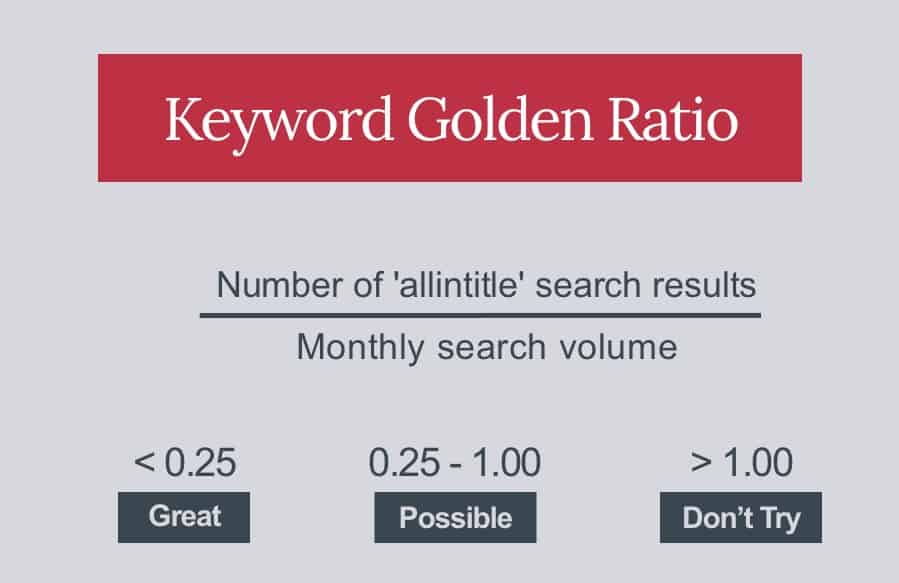
Keyword Golden Ratio (KGR) method
The KGR (Keyword Golden Ratio) method or golden ratio for keywords is the number of "allintitle" search results divided by the monthly search volume(- iConsult Agency editorial note).
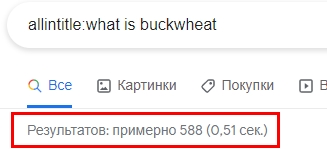
Frequency is 5400 per month
588 / 5400 = 0,11
1. Determine your organic level. In our example it is 20-50 organic visitors per day.
2. Do your keyword research and find those that generate 0-10, 10-20 and 20-50 visitors per MONTH (NOT WEEKLY). Make a list of 30-45 of them.
Use the KGR method (do a keyword reserch with the same search volume to use in content).
By the way, the KGR method is relatively new to me, ONE thing it has done is grow exponentially and now I use it as my primary method, not just as a starting point.
3. Find a contractor or write content yourself for these keywords. Be sure to use keywords that are not related to KGR to place anchor links to commercial inquiries and other important pages. Linking is what helps news sites rank in the SERPs.
4. Publish one piece of content per day for 30 days. Make sure you link new content to your commercial pages and all published avalanche articles (the same ones you published in 30 days - iConsult Agency editorial note) between them.

At this stage, you don't link to past articles until they are pumped organically. Eventually it will start to generate traffic and become suitable for pumping commercial pages, etc.
5. Before you publish your article, add your keywords to the search engine submission tracker along with your domain. This way, as soon as your next article is indexed, you will know exactly what its position in the output is. The tracker also has the advantage of showing the ranking of other pages - their metrics, domain name, social signals, etc. within the top 30 or top 100 if your domain is in them.
It's important to track your content metrics to understand where you are inside the sickle without the influence of boosts.
If none of your pages are in the top 10 for 30-45 keywords immediately after publishing, you're in trouble. If you follow the guidelines, it's impossible not to be in the top 10 for at least one of them. Something is really wrong either with your website, technique or brain. Feel free to fill out an application to McDonalds. SEO is not for you.

6. Thanks to KGR, you should already have an increase in traffic in a month, regardless of the age of the site.
If your average organic traffic has exceeded the current level (over 100 in our example), you can add the next level of keywords, BUT stick to the KGR methodology and the keywords from the previous level.
When you do KGR research, IF you levelled-up in keywords to average daily traffic, then you can select keys of the following levels:0-10, 10-20, 20-50, or even 50-100!
Stay INSIDE your level until the avalanche traffic pushes you out naturally. Starting next month, traffic should increase by a multiple of the number of content posts from KGR. So gather another 30-45 keywords for your content plan and repeat. Once you hit 200 visitors per day, you can move on to 100-200 keywords because you've reached the next level.
7. Find pages that are not in the top 10 of your KGR keyword level. They need link weight to get into the top 10. Link to them from pages that are in the top 10. According to Kyle Roof of pageoptimizer.pro, 3 internal links equals 1 external link. When your KGR avalanche pages have KGR'd, they won't need as much internal linking to get promoted. Your domain is capable of handling that.
Project organization
I've divided the avalanche keys into levels and grouped them into an avalanche project. So when I go into SERPWoo, I can just focus on the keywords I need while I'm working. I also share the folder with the copywriting team so they can see where we're aiming and what pages need to be re-linked.
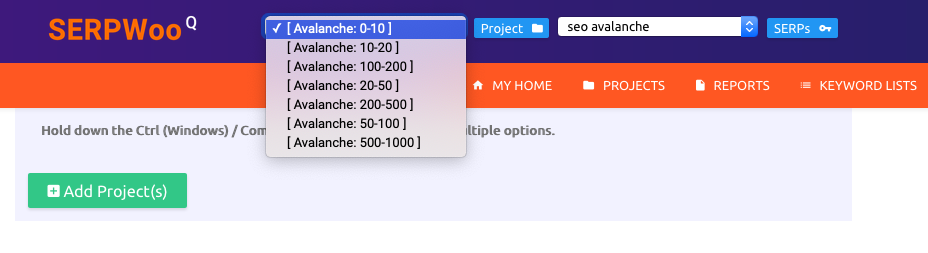
You can use social media to attract traffic and comments to your blog, drive traffic, promote your content and pump up your pages. For most KGR content, you need no more than 1-5 links for low to medium ranked pages to promote them.
So every time you go to a tracker with your avalanche project, look for the lowest ranking pages and link to them from the more traffic pages using appropriate anchors.
If even after that your avalanche pages with KGR couldn't make it to the top 100 - it's definitely time for you to go work at McDonalds.
Also remember, you can move faster with backlinks (external links that lead to your pages). But remember that this technique works without a boost. Save backlinks for conversion and important pages.
8. You may eventually run out of KGR keys. This is normal because after you publish 60-90 articles, you have good organic traffic to tap into.
Remember that Google trusts pages that it already sends traffic to. So one of the most popular and fastest ways to move up in the serp is to get links from previously published pages. This way, you can go beyond KGR and use not only keywords in your range, but also with a keyword search volume (KGR) of 0.25 or higher.
When you publish an article, it should be in the top 100. Find the ones that rank 30-90 and link from those pages to your new pages. Don't forget to mention those pages that are already getting traffic from Google as well.
If a page ranks in the top 3 and gets 1 visitor per month, that page is useless and so is the link from that page. I wouldn't remove it until the traffic is zeroed out since 1 visitor can convert to a sale or click.
9. After the avalanche technique and KGR exhausts itself, traffic should increase by about 10,000 visitors per month in six months.
How do you calculate that?
30 articles at the level of 0-10 visitors per month = ~ 300 visitors
30 articles at the level of 10-20 visitors per month = ~ 600 visitors
30 articles at the level of 20-50 visitors per month = ~ 1500 visitors
30 articles at 50-100 visitors per month = ~ 3000 visitors
30 articles at 100-200 visitors per month = ~ 6000 visitors
30 articles at 200-500 visitors per month = ~ 15000 visitors
30 articles in half a year = 180 articles linked by keywords with KGR.

After the first month you will have 0-300 visitors. After 2 months - 300 + 600 visitors from the next level and so on.
At month 6, if everything is done correctly, you will see a total of 26,400 potential visitors. Let's assume that traffic will only increase by 50%, due to different positions in the top 10 or other factors, you will get 13,200 visitors in half a year.
If you've successfully published 180 articles in 6 months and can't break the 13,200 visitors per day per month mark, it's time for you to go to McDonald's.

Make sure that:
- you have links to your social networks on your site - it's a simple thing to do;
- there are images in your content;
- the content is formatted correctly.
10. The only way to screw up is if you didn't check your serp positions after a month and overestimated your level. OR you overestimated your level. If you published 30 articles and failed to get MINIMAL organic traffic, then something is really wrong with your site or internal SEO.
If you publish a new article, tweet about it with popular hashtags and an image. Here's a screenshot of two tweets, which one do you think has more reach?
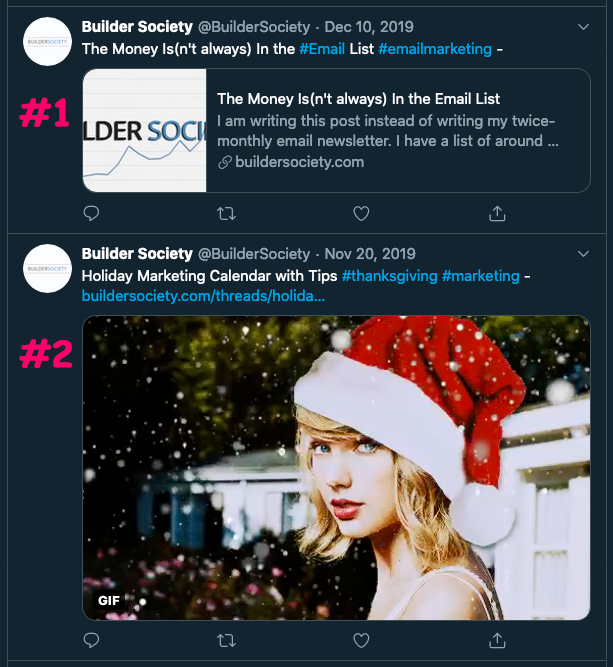
Popular hashtags help content appear in searches for it. Google indexes hashtags too, google "#marketing" and you'll see a carousel of Twitter, YouTube and other platforms. Google queries pages and finds hashtags on them!
Think Google won't index a page that shows 2-10 popular hashtags from different platforms? The indexing problem has been solved.
Bottom line
When you understand how it works, you know why and how to proceed. If Google doesn't pessimize your main domain, it won't take away your natural traffic that came after the Avalanche SEO Technique.
This method helped the rise of WikiHow. The site started with low level articles and later improved their appearance and conquered the top of the internet.
Additional bonus
P.S. Also don't forget to block bad Ahrefs bots (AhrefsBot), SEMRush (SEMrushBot), Majestic (MJ12Bot) and bots of other tools on your site.
They will still be aware of links leading ON your domain, but they won't be able to learn about links that come from your domain. They won't be able to crawl your site, and they won't investigate internal linking or your content.
They will still be able to find you in search results, but to see your avalanche pages for KGR queries, they need to recognize the queries themselves.
You don't want to let the entire SEO world know what's going on with your site, so blocking these bots will create another barrier for your competitors.
I use Broken Link Checker to see what Ahrefs has about SERPWoo (I blocked them years ago).

Unfortunately, BuilderSociety did not:
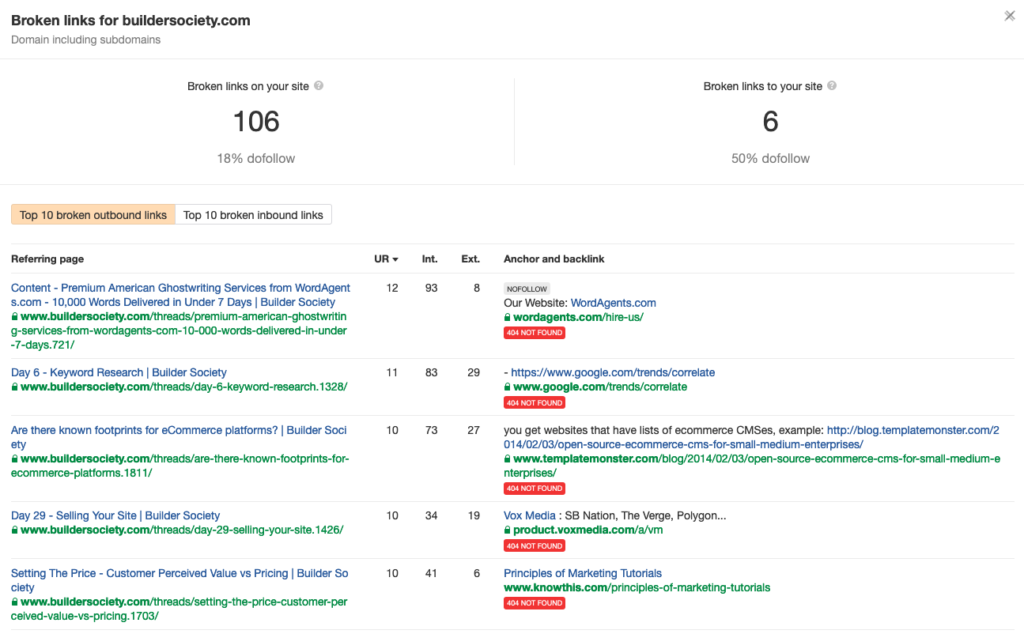
Simply blocking these crawlers gives your competitors less information about your site.
And now briefly for projects with zero funding / individuals with zero authority - order 180 articles with selected KGR-keywords related to your topic and publish them daily for the next 6 months.
Using math based on your level of WEEKLY Google ORGANIC traffic, you'll understand what WEEKLY traffic you should be searching for keywords with.
Use KGR keywords to boost your commercial and other important pages.
A new domain with zero power, no backlinks will never rank for a keyword that goes beyond Google (3000 per month in our example). You have to gain Google's trust so that it will trust you with more traffic. That's why you start at the bottom - the 0-10 visits per month level.
Use this technique on mature sites to build relationships, refine categorization and show Google what your brand does. If you chase keywords with 10,000 hits without pages that show your expertise in the subject matter of that keyword - HOW MUCH will Google give you traffic? Especially without a boost?
SEO isn't hard, many people just don't have the "How to start from scratch" plan that is sorely lacking in this field.
Related Articles
- N8N service for automating routine SEO tasks
- A complete SEO checklist for blogging: how to write articles that drive traffic
- How to use Instagram for SEO
- How to manage your reputation on Google: a guide to SERM for businesses in 2025
- Checklist for technical SEO audit of a website
Thank you for your sharing. I am worried that I lack creative ideas. It is your article that makes me full of hope. Thank you. But, I have a question, can you help me?
Thank you for your sharing. I am worried that I lack creative ideas. It is your article that makes me full of hope. Thank you. But, I have a question, can you help me? https://www.binance.bh/register?ref=GGYHGRE
Your point of view caught my eye and was very interesting. Thanks. I have a question for you.
Thank you for your sharing. I am worried that I lack creative ideas. It is your article that makes me full of hope. Thank you. But, I have a question, can you help me?
Thank you for your sharing. I am worried that I lack creative ideas. It is your article that makes me full of hope. Thank you. But, I have a question, can you help me?
Your point of view caught my eye and was very interesting. Thanks. I have a question for you. https://www.binance.bh/pt-BR/register?ref=GJY4VW8W
I don’t think the title of your article matches the content lol. Just kidding, mainly because I had some doubts after reading the article.
Thank you for your sharing. I am worried that I lack creative ideas. It is your article that makes me full of hope. Thank you. But, I have a question, can you help me? https://accounts.binance.com/hu/register-person?ref=IQY5TET4
Your article helped me a lot, is there any more related content? Thanks! https://www.binance.com/fr-AF/register?ref=JHQQKNKN
I don’t think the title of your article matches the content lol. Just kidding, mainly because I had some doubts after reading the article. https://accounts.binance.com/sk/register-person?ref=WKAGBF7Y
I don’t think the title of your article matches the content lol. Just kidding, mainly because I had some doubts after reading the article.
Your article helped me a lot, is there any more related content? Thanks!
Your point of view caught my eye and was very interesting. Thanks. I have a question for you.
Your article helped me a lot, is there any more related content? Thanks!
I don’t think the title of your article matches the content lol. Just kidding, mainly because I had some doubts after reading the article.
[…] topics so articles can complement each other. We have an in-depth article on our blog to study on KGR (Keyword Golden Ratio) and building “avalanche SEO” that can help you understand keyword selection and building a strategy on your […]