

After we translated our article about the Avalanche SEO Technique, it gathered a lot of attention. Those of you who have put this technique into practice have probably encountered many questions.
In the 3 years since the article was written, a lot of questions have accumulated in the comments under the article. The author of the methodology answered them and also gave some additional recommendations.
We found these answers very helpful. We have grouped them together and translated them so that everyone can use them.
- Does the cannibalization problem arise when creating 10 long tail articles instead of one powerful article that targets the main keyword query?
- Will Google raise a site up in the rankings for various KGR queries based on query frequency and internal optimization alone? Or will internally linking 100 articles to each other, where applicable, also be a positive signal in Google's eyes?
- How many words (approximately) should I write in an article with such a low frequency?
- What's up with the ORM example? Can we get more details?
- Do you post every new article on social media?
- What remains unclear is why you would include non-KRG words in a post. And what that looks like in practice
- Explanation for "If you've successfully published 180 articles in 6 months and can't get past the 13,200 visitors per month mark, it's time to go to McDonald's."
Does the cannibalization problem arise when creating 10 long tail articles instead of one powerful article that targets the main keyword query?
No.
If long tail articles would grab themselves KGR keys then there would be no need to create new content, but they don't. We target KGR keys and don't put much effort into these pages going forward.
What difference does it make if you have 10,000 pages on your website, each of which brings you 1 visitor per day? That's still 10,000 visitors a day to your site. Google sees that it trusts you with 10,000 visitors per day and you build internal links to the following pages when you publish keywords with higher frequency and then you start ranking even higher.
You need to completely change the way you think about marketing and SEO because a lot of what you believe is false or half-true.
I will say a few things that may seem controversial, but they are supported by the data.
Counterargument #1: A single domain can rank multiple times in Google search results for a keyword. Logic may suggest that this is impossible, but it happens VERY often.
(This and other screenshots of visibility and positions are made in SERPWoo service owned by the author of the article) - iConsult Agency note.
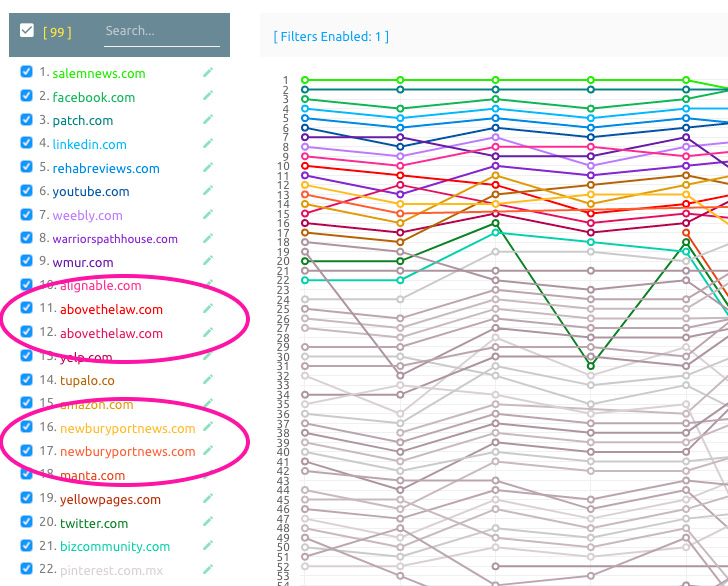
If you can't make the top 1 in the top 10, why not make a few spots in the top 10, 20 or 30? It is better to fish with nets, not with one single rod.
Counterargument #2. A single URLcan rank multiple positions in Google search results for a keyword WITHOUT participating in a featured snippet or special data; just organically: 1 URL ranks multiple positions.

No one wants to hear it...
BUT let's take my second favorite person in the world (the first being me, of course); Natalie Dormer - same domains taking multiple positions:
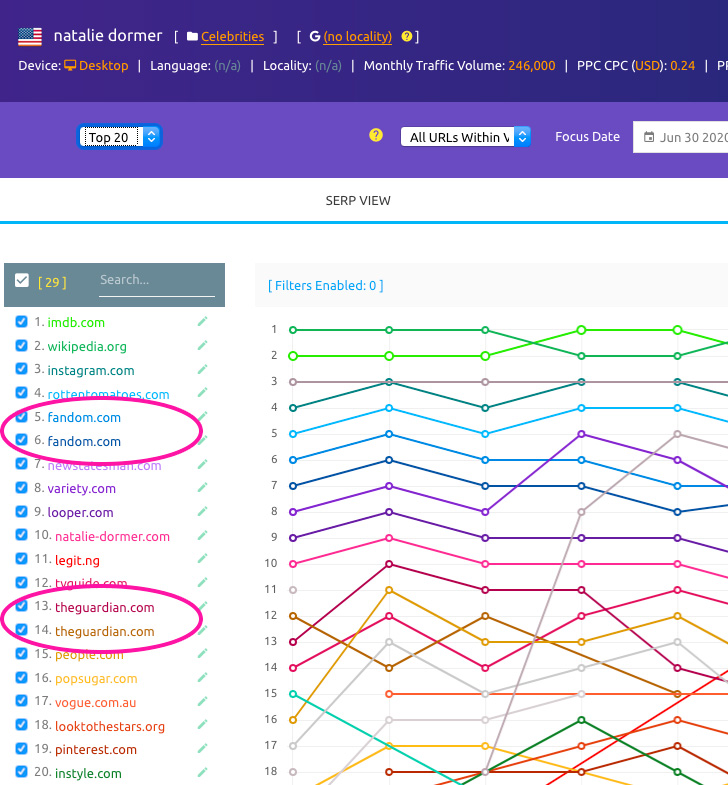
--
The same URL ranks multiple positions for the same keyword for MONTHS:
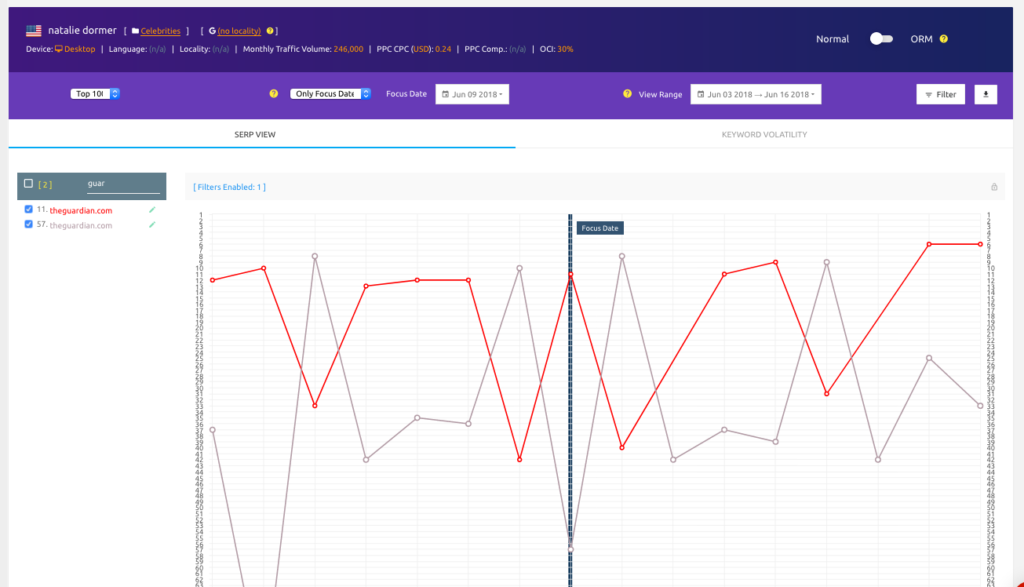
The only difference is the description is different for 2 different positions, but the URL is the same.
https://www.theguardian.com/film/2015/nov/23/hunger-games-mockingjay-natalie-dormer-game-of-thronesFirst position:

Second position:

What's up with your faces, SEO guru?
How long has this been going on? From January 11 to July 22, 192 days, that's more than half a year, it's not an anomaly of Google's algorithm update.
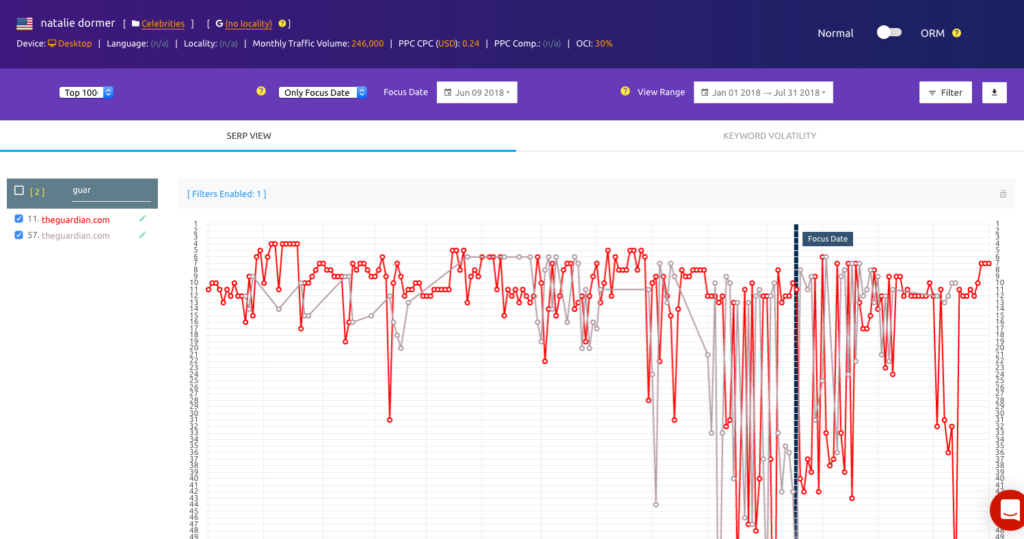
I know this because when you analyze SERP data, you need some kind of key (starting point) to identify the data. Naturally, it makes sense to use a URL as the key, because it is commonly believed that a URL cannot appear more than once in the top 100 results - and that is WRONG.
So in my programming it was $SERP[KEYWORD_ID][DATE][URL] - but that day the charts were wrong, and I made this discovery because an OTHER user reported seeing the same thing with their keywords. The URL could no longer be a keyword. I had to create a variation, so the first entity was URL_1 and the second was URL_2.
It took tons of programming and a mind-boggling thought process, but it works and SERP View can now display data correctly.
--
So if we know that there are cases where the same URL ranks multiple positions in the top 100 for a keyword - with evidence; and we know that the same domain can rank multiple positions in the top 100 for a keyword - with evidence - then why should we worry about keyword cannibalization?
The goal is to somehow "merge" pages to create a more powerful page. But first, that more powerful page doesn't rank for KGR keys, so it doesn't make sense. And second, how can you merge the same URL?

Some might say "well, that's rare" - if it was that rare, I wouldn't spend weeks rewriting multiple interfaces to adapt it, especially if a number of other users see the same thing. There are a lot of crazy things I see in SERPs and others see too, Ryan McLaughlin found that Google tests CTR by putting your URL higher for a day and watching the (user) response:
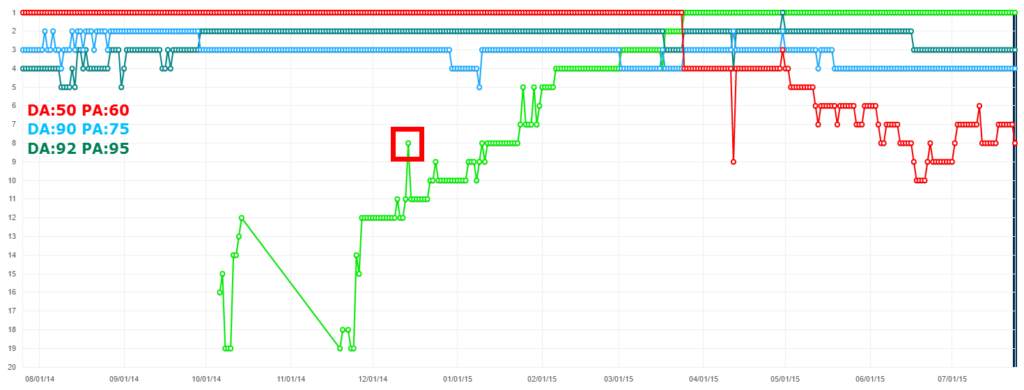
He wrote a guest article about this for SERPWoo 5 years ago, we just never published it because it was too much for the SEO world, he talked about CTR manipulation and.... well. overall SEO Deep State is having a big impact. The SEO community ALSO still doesn't believe(the author is referring to the burgeoning community - note) that"SEO domain age" matters... Just unbelievable! (WHOIS creation date is NOT the domain's first day, your first day is when you get in Google's index).
Back on topic. Also, we are targeting KGR keys that are rarely googled based on frequency. So, if we are already playing with a plan beyond standard SEO, then we can't think like a standard SEO, we need to throw out the standard SEO game plan.
This method boils down to targeting one keyword and that's it. Don't waste your time trying to be clever or creative, this is where the theory falls apart because the next step is "why not just target keys with a frequency of 100++ and soar to the top". And then you lose the whole point of this defense of multiple moats of water trying to think ahead.
Will Google raise a site's ranking for various KGR queries based on query frequency and internal optimization alone? Or will internal linking of 100 articles to each other, where applicable, also be a positive signal in Google's eyes?
You should always interlink all content - each link tells Google that this page has some relevance. Those with indexing problems don't have internal links leading to the page - and they wonder why Google doesn't care about their page. Hmmm....

Google is looking for the most accurate answer: if your site contains content that the user is searching for, you will rank high. KGR solves this problem by finding other pages that are super honed to the keyword query - if it's a weak SERP, you can slip in there with your zero authority, since you're giving a verbatim answer to the question the Google user is searching for.
--
For the sake of analogy, imagine that you want to get from New York to California. The more resources you have and the more powerful your boost (the meaning of boost is explained in Part 1 of this article), the faster you will get there.
If you have a private jet, powerful backlinks + authority + advertising money, you'll get there faster.
If you can only afford a commercial flight, the journey will take longer.
If you only have a car or bus, the journey will take even longer.
If you have zero resources at all, you'll have to walk. You will get there, but it will take a long time.
This method is walking because you don't have the resources. Over time, generating income from traffic, you will go from walking to running, then switch to a bicycle, then to a car, then to an airplane, and eventually, perhaps one day you will reach your destination on your Privet Jet.
The basics of internal SEO and understanding how to turn on the website lights need to be applied. You need to know the basics - it's the same as having the legs to walk. If you don't understand it at all, you'll probably crawl there, and hopefully you won't give up before you get there.
SEO Basics:
- Title and H1 contain the target keyword.
- Images within the content.
- Video improves the user experience - not necessarily.
- Your website loads quickly on mobile and desktop devices, pagespeed + good hosting.
- Remove the thousand and one connections from your ad network that are shitting your site's performance.
- Having your brand on social media, web 2.0 and other places where you can show Google that you deserve a place in their index. And I don't mean empty Pinterest accounts or spammy Twitter feeds. Spend some effort on your brand's online presence outside of your website.
- Sitemap + robots.txt. Adding a sitemap to Google console helps.
- If you can add schema - great. If you can mention entities, even better.
--
You can always add a little more, but being an online marketer, when you visit a website, you know what makes the site look trustworthy and what doesn't. Make sure you implement these elements in conjunction with your brand representation, and you'll have no problem getting into Google's index.
If you can't fulfill at least one of the above conditions, Google won't even promote you for a query with 100 visits per month, let alone 10,000 queries per month, because frankly, nobody gives a shit about your brand. Google certainly doesn't. And since Google, via Chrome, can't tell if people are visiting your site or searching for your brand, WHY would it start sending you tons of traffic?
You are a nobody, so they won't do it. So start from scratch, literally walk or crawl towards your goal. This method is for those who have nothing but want to start.
As for the guys who have the resources and time, they start at the top while building a foundation. But if you don't have those resources, you'll create a keyword-specific landing page with a frequency of 40,000 or 1,000 per month and beat yourself up because you're not hitting the top 10 even after 6-12 months of regularly checking your 0 visits in Google Analytics.
You will surrender.
If you can't get to the top for queries with a KGR of 0.25 that have 0-10, 10-20, 20-50 or 50-100 visits, literally can't get to the top 30 - you have a serious SEO problem and should take basic SEO courses.
What number of words (approximately) should you write in an article with such a low frequency?
Counterargument #3: I never count words when creating content. I wouldn't be able to tell you the word count of the articles I've published. I just make sure it answers questions and use "Peopl also ask" as starting points for questions and content I should include in the article.
I think SEOs have gone too far into the "perfect science" of things like measuring ingredients from a recipe on cooking. You lose the art and more importantly your tone and voice when you limit yourself to "word count".
Imagine me saying: "For this article about avalanche SEO techniques, I'm going to use 2,000 words." That in itself limits me, preventing me from thinking "how will this benefit the end users". Instead, I start worrying about freaking word count as if it will give my text better flavor - it won't. It will create flavorless shit content in the end.
Q: Does it make sense to order cheap content from Fiverr with a KGR keyword and then finalize it? I realize that internals are a priority, but does the quality of the content matter? Algorithmically speaking.
Don't post content that will need fixing later. Do it right the first time, because you're trying to get in the top NOW within 2-14 days of posting the article. So if someone comes across your content that isn't formatted, they're going to leave and it will ruin the whole idea because Google will see that rejection and think your content is garbage.
First impressions are important, in life and online.
Q: Also, continuing this theme - do you adjust H2, H3, etc. for other keys with KGR <0.25, or do you strictly stick to what's in the title throughout the article?
No. I noticed I forgot to mention that you need to include HF and NF keywords and other high cost-per-click keywords in your content. That way, you can do internal linking to articles that are customized for higher HF keys. And KGR keys should be used only for H1 and title. And then you need to answer the user's question based on their intent.
Add questions from Quora and "People also ask" and "Topic Queries" to your content to make it more comprehensive. That way, when you write more important articles, you can go back to your KGR content and link from it to those higher-level articles. That's what a foundation is for, to lay the groundwork for your skyscraper.
An example KGR of a keyword I'm competing for is"How to check a company's reputation", search volume is 150 visitors per month, All In Title = 26, which makes KGR = 0.17.
In this content, I'm going to use ORM (Online Reputation Management) keywords and other position tracking keywords that have a much higher frequency. And I'm going to link internal pages for ORM keywords to the ORM page, and for position tracking keywords to the position tracking landing page.
This has the added benefit of putting more expensive CPC ads on my site if I use Adsense, because I'm talking about high frequency and high cost per click keys in my content. So my Adsense will make me more money 🙂 )
This is one of those things that I take for granted, and I assume people know it. To make more money with Adsense, you need to use more high CPC keywords in your content.
There is a higher level of Avalanche SEO Technique. When using KGR, find the keyword among the KGR words with the highest frequency or highest CPC. In my case, it's "reputation management" with a frequency of 5,400 versus "online reputation management" with 2,400.
Now I search Google for "reputation management" and see if I can find questions on Quora or in the "People also ask" results. From there, I can add the answers to those questions to this KGR article and also get ideas for other articles about "reputation management". Later, when I create new articles about reputation management, I can come back to this KGR article and link to it from the new articles.
The added benefits of KGR content is that it's already indexed, so my new articles, once I link to them, will be indexed faster and get more link weight.
These foundation-building articles are designed to build your foundation and protect it from destruction and enemies trying to invade your territory.
Note that the content around the KGR article is in a hopper, it's the bottom of the hopper, securely protected, so it can link well internally to higher-level articles.
Don't just order content and put it out there, have an action plan of what your end goal is. In my case it's to promote SERPWoo for online reputation management software and tools.
What query wording do you guys use on google to find out the KRG of a query?
broad match - allintitle:keyword query
vs.
phrase match - allintitle: "key query"
Nothing has changed, I use double quotes.
This situation is similar to when people ask if a digital strategy course written 5 years ago is relevant. If it's some "trick" or "advice", the methods may be outdated because tips and tricks are situational off-the-cuff tactics. Strategies, on the other hand, give you a macro understanding of what you are trying to achieve, and then you use the tactics to implement the global strategy.
It's like warfare - will the tactic of outmaneuvering the enemy from the side go out of style or not? Probably not anytime soon, not until we fly spaceships that can move and fire in all directions. When a ship has no front, back, and sides, then you can't go around it. But you can bypass anything that has sides (bypassing = hitting from the side). Bypass tactics have been used in warfare for thousands of years, and they are not going away.
Our goal is not to teach "tricks" that work for a few weeks or months, like SEO gurus do, and whose techniques are then destroyed by spammers. KGR has been around for years, and there are still hundreds of KGR terms available in every industry. Why? There are new questions, data and ideas in your industry, and people will continue to ask questions about them.
I'm going to make the content half unique and with a lot of minutiae as I have some experience in creating database-driven (DB) sites, but I want to ask if this will somehow affect the site negatively, and if so, why and what to avoid if I want to do it right. Could it cause penalties for superficial content?
Database sites still exist, I still have a couple of them. But choosing this path means you will have a ceiling for your "moat of water". There will be no growth once the database site is 100% operational.
The avalanche SEO method is designed to get an increasing flow of traffic. A DB site that gets random queries about some dentist and his name does not provide a steady stream of traffic. Since it's not constant and these random queries literally have a frequency of 0, you're building a sandcastle in the desert.
To use an analogy: you are NOT traveling from New York to California; you go to the middle of nowhere - the desert where literally no one wants to be, and build a sandcastle. So one random passerby will stop by, but if you can't provide any real value, you just devolve into the mindset of a black-hearted spammer.
The only way to internally relink a DB site is by city, state, zip code. With avalanche SEO techniques, you internally relink HF and NF keywords to redirect PageRank power to your business pages. A big database with a bunch of names and businesses doesn't do anything like that, it just creates a bunch of useless pages on the internet.
With KGR and relevant content that ANSWERS the questions people are asking in your topic, you create value.
You have to change your way of thinking because by providing value, you can charge more for ad space, increase product/service prices or generate more AdSense revenue. You can also grow your email marketing because people see real value in your brand.
Can you develop email marketing for a DB site? Ask yourself which people would give their email to a database site in the first place? If they do, it's unlikely to be the smartest people.
If you can't get people to subscribe to your newsletter, then you're clearly not providing value to the audience - this should be a clear sign of value, because real value, like FEInternational Newsletter, provides something of value to the audience. What can a database site provide? It's polished spam at best.
What about the ORM example? Can I get more details?
Okay, here's an example.
I give an additional example that clarifies this here: Counterargument #3.
"How Do I Check A Company's Reputation" has a frequency of 150, with "All In Title" = 26, so KGR = 0.17.
My service is aimed at people doing "online reputation management", ORM - so at some level I've already done that research and have commercial pages dedicated to those keywords. If not, I'm doing research on ORM next.
Then I add ORM content and talk about it in the context of SERPWoo in the KGR article. But, of course, I respond first to the intent to which this KGR article is dedicated.
Next, I'm re-linking the keywords about ORM that I've added with higher level money commercial pages.
Google comes to the KGR keyword, indexes it, then follows the links to commercial pages about ORM and in the long run improves their ranking too.
This is the fundamental linking from the fundamental pages at the base of your reliability hopper upward to the commercial pages.
You write "Analyze the semantics and find the keys that generate 0-10, 10-20, and 20-50 visits per MONTH (NOT per DAY). Find 30-45 of them."
I assume 30-45 per level? (I.e. 3x 30-45, totaling at least 90?) Once I have those 90+, then I start doing KGR?
No, that's just the minimum. But if you're using Fiverr, they won't limit themselves to frequency like we do, so you'll have to create multiple jobs in different categories of your niche, because maybe only 5 or 10 will come back with keywords with frequencies 0-10 in one job, and you need 30 articles.
At the end of the day, you're the one making the content plan for your site, so you should know what's going to happen over the next 30-60 days and make adjustments as needed.
In SerpWoo, the frequencies in the keyword tool are absolute. That is, they are either 0 or 10. If there are 0 results in AllInTitle, but the frequency is also 0, it is KGR infinity.
You will have to decide if the article/keyword makes sense for your intent and your audience. Just because an article with KGR targets a keyword with a frequency of 0 does not mean it will NOT attract traffic.
SEO secret: Web pages can rank for multiple keywords.
You're overcomplicating things.
Web pages rank for a lot of long-tail keyword phrases that 99% of keyword collection and analysis tools don't even know about.
Approximately 30-50% of WEEKLY searches on Google are keywords that Google has never seen before, which means: if GOOGLE hasn't seen them before, no other keyword analysis tool can tell you about them. But Google still has to provide that user with some page to fulfill their query.
So in the case of my "How Do I Check A Company's Reputation" key, I would obviously also rank for "How Do I Check A Company's Online Reputation", right?
We need to take a step back and look at the whole picture.
Do you post every new article on social media?
This is the most important component of the Avalanche SEO Technique - it's Step #10.
You have to use hashtags with high traffic volume to get into the search engine index for those hashtags and thus attract the attention of search engines.
Type "#jackiechan" into Google and you'll see that the top search positions include Twitter and Instagram hashtag searches. If you have a post about Jackie Chan and an article about Jackie Chan, you're attracting search engine interest, [cough cough ] pages are indexed [/cough cough]. You need to include a high-traffic hashtag in your social media posts.
It has absolutely nothing to do with the number of subscribers or who you subscribe to. This is the most important step.
--
You should not forcibly index pages using the GSC. Google prefers to find URLs on their own. They claimed this repeatedly before the advent of GSC, WMT or anything else.
So how do you get Google to find URLs on its own? Post your URL on social media with your main keyword as a hashtag. Google does have Twitter carousels in their search results - they are constantly monitoring Twitter and social media platforms for viral activity and recent news, so they will "naturally" find your URL through trending hashtags.
With hashtags it's simple, if I'm targeting health insurance, I'll use #HealthInsurance and then 2-4 other related tags. If it's a local tag, such as #Chicago, I'll add it. No need for in-depth keyword research for hashtags or any tool.
What remains unclear is why to include non-KRG words in a post. And what it looks like in practice
This is so that posts can rank for other queries and long-tail versions of those queries, such as "iPad apps for moms". If you think "iPad apps for moms" is a good query (its frequency doesn't have to be below or at the same frequency as the KGR queries you're targeting, it can be higher).
Don't forget that Google also shows chunks of text from the page content and now has some sort of autoscroll mechanism or something (I can't remember the name of it now) where that "iPad apps for moms" snippet is highlighted in the search results.
Alternatively, you can use keywords like "iPad apps" (let's say it has a frequency of 1 million). Obviously, you HAVE to link internally to a money page honed in on "iPad apps". Three (3) internal links equals one (1) external link according to Kyle Rofe.
Remember, KGR pages are at the base of your pyramid and you link up from them to more powerful pages, pillar pages, and monetizable pages. You want traffic to flow from the bottom of the pyramid to the top, where the calls to action that bring you the most revenue are at the top.
You need to visualize the user's path through the site to the optimal CTA. If this were an affiliate site, I'd collect their emails and other contact info first. But that's me, because I'm thinking long-term and building a brand.
Explanation on "If you've successfully published 180 articles in 6 months and can't break the 13,200 visitors per month mark, it's time for you to go to McDonald's"
THEN - it's critical to note that if you've published 180 articles/materials and are NOT getting 1,000 visitors per day, something is going WRONG because those are very modest numbers. And the articles, even though they are KGR compliant, are still getting additional traffic from the various variations of the targeted keywords they are honed for.
So even a modest doubling is 1,760 per day, which equates to 52,800 visitors per month. Guys, these aren't some astronomical numbers. Especially if you use "boosts" like internal linking, social media, domain age and Google trust.
And as mentioned here, make sure you're building up and down at the same time - meaning that the avalanche SEO technique should be ADDITIONAL to your current content marketing and other marketing activities. You're building a foundation that supports the structure, but the top has to be the STRUCTURE itself!
- N8N service for automating routine SEO tasks
- A complete SEO checklist for blogging: how to write articles that drive traffic
- How to use Instagram for SEO
- How to manage your reputation on Google: a guide to SERM for businesses in 2025
- Checklist for technical SEO audit of a website
- Web Archive for business and SEO: a guide to using it
Thank you for your sharing. I am worried that I lack creative ideas. It is your article that makes me full of hope. Thank you. But, I have a question, can you help me?
I don’t think the title of your article matches the content lol. Just kidding, mainly because I had some doubts after reading the article.
I don’t think the title of your article matches the content lol. Just kidding, mainly because I had some doubts after reading the article.
Your point of view caught my eye and was very interesting. Thanks. I have a question for you.
Thanks for sharing. I read many of your blog posts, cool, your blog is very good.